Showing posts with label fur notes. Show all posts

Sunday, December 26, 2010

Noir Part I

Many thanks to Katie of Scentzilla and through her, Jill Martin Clements (aka rockinruby throughout Ebay/Internet circles) among others for many of the details and specifics of Weil Parfum history.

Weil Fur Ad 1920

Weil Fur Ad 1920

Weil Fur Ad 1925
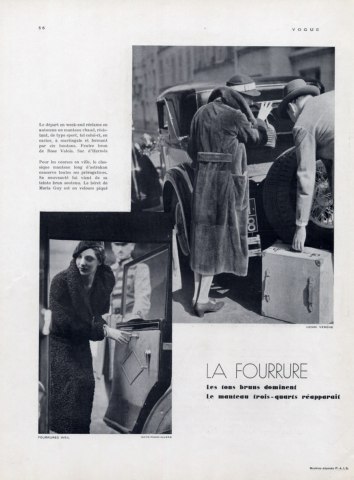
Weil Fur Ad 1932

Furriers by trade, perfumers by destiny. Since 1920 Alfred, Jacques and Marcel Weil enjoyed great success as designers practicing in the trade of fur at Les Fourrures Weil. Then in 1927 a wealthy client requested a perfume designed especially to sweeten fur without damaging it and Parfums Weil was born. The brothers hired talented nose Claude Fraysse to create the first Weil parfums. Fraysse had trained at Firmenich; he was considered to be the very top nose at Yardley, which was one of the largest commercial perfume houses at the time. Fraysse was famous not only for his own work as a perfumer but because his talent overflowed into his family tree. Three of his children went on to become perfumers of note, as did at least one of his grandchildren.


Above, Jacqueline's brother Andre Fraysse (1902-1976) in the late 1920s. He became Lanvin's in-house perfumer in 1927.

Early Weil Perfume Print Ad 1928

With the help of his daughter perfumer Jacqueline Fraysse, Claude created the first trio of perfumes offered by Weil in 1927/1928, the so-called fur perfumes: Hermine- a sweet tropical floral scent, Chinchilla Royal- a jasmine/rose blend and Zebeline- a grand floral chypre with deep vetiver/oak notes.

1936 Weil Perfume Ad for Zibeline
1938 portrait of Weil's fur design 'Hermine'

Jacqueline Fraysse must have been a fascinating person. She worked in a male dominated field at a time when most young women stayed home, or if they were adventurous, needy or otherwise inclined, worked in other people's homes. She came of age in the electrifying, emancipating atmosphere of 1920s Paris and New York- the Jazz Age. Yet she lived and worked under the watchful eyes of her perfumer father and brothers. Judging from the quality and success of the perfumes, she flourished even throughout the difficult years of depression and war that followed. In 1934 her first solo perfume- a fruity-floral-woody scent with an exotic Asian/Polynesian theme- was christened: Bamboo.

 1936 Weil Perfume Ad for Cassandra

She followed up with Cassandra, a perfume "anise like... a hint of stryax, fruits and florals" (notes from Perfumed Court), released in 1936. Billed as a spicy feminine perfume light enough for day but bewitching enough for night; the story says that it took Jacqueline two years to perfect the formula. Noir was her third independent release debuting in 1937.

Weil Perfume Ad for Noir 1937

 1939 Weil Fur Ad

It's hard to get a feel for Noir before smelling it because there's hardly anything to go from. Unlike her other perfumes, there isn't anything like a list of notes or even as much as an advertising tag line for Noir.

I believe there are published sources with notes for many of Weil's perfumes (that I haven't got....) but if Noir is there, no one is telling. Yet searching for notes lists of Weil's perfumes on the Internet yields some information. 

Secret de Venus 1933: A woody oriental chypre edp with top notes of lemon, cassis, peach, bergamot and grapefruit, heart notes of jasmine, gardenia and freesia on base notes of cedar, sandalwood and vanilla. Claude, Herbert, Andre or Jacqueline may have composed this one alone or together or with help from each other- I do not know yet I can't help but feel it must be Claude and or Jacqueline. Advertising copy for SdV at the time claimed: "It's the divine perfume oil to be smoothed on after bath or shower and grows more intense the longer you wear it." I cringe at some of the sky-high prices asked for many vintage perfumes but Weil's SdV scent in the SdV oil is worth its price.

Weil Perfume Ad 1942
Weil Perfume Ad 1945
Antilope 1945: A floral-woody aldehyde chypre parfum with notes of tangerine, neroli, galbanum, acacia farnesiana, narcissus, hyacinth, ylang-ylang, May rose, lily of the valley, oak moss, civet, sandalwood and musk. Composed by Hubert Fraysse, in at least one of its versions, it is of a lighter style than the earlier Weil perfumes.  Notes for both of the above perfumes are quoted from Cleopatra's Boudoir and Perfume Intelligence. And so the story of Jacqueline Fraysse, one of the rare early 20th century female perfumers of note, fades away into the mist. 

But after all, Noir is a Weil perfume and Weil has a fascinating story as well.

Marcel Weil died from pneumonia in 1933. In 1940 the Weil family fled the war, closed up their Paris shop and moved to Bordeaux for a short time. The surviving brothers then came to the United States where they bought out their US distributorship and used the space to open their first perfumery/shop. Located on Fifth Avenue in the heart of Manhattan, they manufactured two of their perfumes- Cassandra and Zebeline- right there on sight. Jacques even created a new exclusively American Weil perfume in 1941 dubbed Cobra.

1945
Once they came to America, the Weil's developed the Secret of Venus- a unique bath and body oil formula. Around the same time, they created a new perfume called Secret of Venus. To further mystify us, they created versions of all of their scents in the Secret of Venus oil formulation. So you might see a Weil Noir Perfume, and then a Weil Noir Secret de Venus Perfume oil. According to Katie, the SdV oil formulas smell differently than their pure perfume counterparts. She believes they contain ambergris and says they smell warmer, are longer lasting and better then the perfume versions. Having only smelled Secret de Venus in the bath and body oil form, I can't compare them but I agree with her enthusiasm for this intoxicating scent.

Secret de Venus line up: Scentzilla
Weil Perfume Ad 1950
Weil Fur Ad 1957
Weil Fur Ad 1960
Weil discontinued Noir in 1969. As I began work with it, I wondered about the only scrap of information I had about the perfume- it's name... Stay tuned for Noir Part II.

Weil Perfume Ad 1977

The Vintage Perfume Vault, where the scent of yesterday's vogue lives. 

images: 
1925 Weil Furs ad at MsBlueSky Flickr photo stream
All other Weil Print ads, hprints
Andre Fraysse from PerfumeProject.com
Weil Secret de Venus bottles from Scentzilla

Saturday, May 30, 2009

Lost Perfumes: FAUN by Ravel

Could this be the start of a 'Lost Perfumes' series? Faun is one of the first perfumes I added to my vintage perfume collection but it's been around for so long that I'd sort of forgotten and neglected it. If you saw my post from last week, you may recall I posted a photo of the bottle. It resembles a 1945-1950 era Chanel bottle- spare and squared in shape with a plain black cap. In the hand, it somehow feels cheaper than Chanel's version. The label is slightly off, both in the cut and lettering... Perhaps the packaging had something to do with why I wasn't really drawn to try what was inside, at least initially. But recently I decided to take a closer look at this unknown mid-20th century creation.
A little preliminary research lead me to discover that the details about Ravel and it's perfumes have mostly been obscured by the passage of time. Even though Ravel is a relatively modern perfume house that existed in the late 1940's and 1950's, if you know vintage perfumes at all, then you'll know that 50 or 60 years is a long time in perfume years. Smaller 'independent' perfume houses tend to pop up and fall away rather quickly. And it's not just the smaller houses- it seems that most perfumes fade from our collective memories with lightening-like speed.

In fact one wonders about the fate of the multitude of modern releases, and the niche companies that seem to pop up overnight. We know that the perfumes of today will likely face a similar fate since very, very few perfumes really stand the test of time. There are many reasons for this poor longevity, from weak business models to inconsistent raw materials and supply problems to simple bad luck. But mostly I think it is because perfume is like art. Very often, once you've created something, the animus leaves you. Or perhaps there are too many poorly conceived start-ups, without support for talent to grow or the vision to allow it to florish.

At first perfume may seem like an easy and cheap thing to produce. With a modest upfront investment in chemicals and creator, there is big profit potential. But it is deceptively simple. Fine things, truly fine things that is, tend to take time; original creations are not so easy to produce as uninspired knock-offs. So ultimately many of the 'new' things we see are not really so special and there is an almost constant turn-over of even the so-called successful 'hit' perfumes.

But even for it's time, Ravel was one of the smaller perfume houses based in New York. Like many, it touted a French connection, listing Paris as a second site as well but with practically no advertising history and no presence in famous reference works or collections (that I know of, yet...), there is little else to say about it. It seems Ravel was one of many start-ups that florished in the glow of post WWII optimisim but it lasted less than a decade. The perfumes of Ravel include: Adagio, Pagan, and Pagoda (a little metal bottle of this perfume recently surfaced on the web; if it's not been plucked up yet, you may still be able to find it, and if you do, please let me know what you find); all three of these were from 1945. Faun came out in 1946, followed by the trio of L'Amour En Rose, My Fair Lady and Moments De Passion which were released in 1955 and the final known release, No. 9, came out in 1956. Pagan and Faun caught my eye right away as the most originally named and the most desirable of Ravel's perfumes to collect... but I can only discuss Faun, since it's the only one I've experienced.

And what of the perfume in question, this Faun? As I've said, the name itself is intriguing. The image of the Faun is that of a half human, half deer that is usually but not always male. Looking at iconic images of the Faun, it seems clear there is an implied sensuality and rustic animalic quality is suggested by use of the Faun image. At its opening, Faun is bursting forth with juicy bergamot and smells at first like a typical hersperidic cologne. Very soon the citrus is joined by aldehydes which lift and intensify the composition, taking it more towards a typical perfume. Early on in the scent, I sense a slight turn toward cool green and slightly powdery chypre notes- there is a restrained plum-prune, mossy, mushroomy accord that typifies Chypres of this same period for me. Yet, smelled side by side, I see the accord is very hushed in Faun.

Soon the perfume turns again, the fresher citrus elements at the forefront bolstered by a rooty, effervescent middle in which orris and the rich, smooth, softness of fur notes shine. Fur notes in perfume have almost mythical status today. We do not see these notes often in the most modern compositions yet at one time fur was perhaps one of the most celebrated of notes for feminine perfumes, famously referred to in the poetry imagery of Baudelaire.

Fur, like musk smells heavily of animal but Ravel's Faun does not turn on us, nor bare its teeth, thanks to a generous helping of dry patchouli that anchors the composition perfectly. The patchouli plays up the tingle of salicyclates and prevents the perfume from going too far toward mossy green shadings of a proper chypre perfume. Along with the patchouli and fur, the base of the perfume reveals itself to be a proper, very classic and somewhat salty and stout leather.

Amazingly free of overt florals, Faun lives up to its androgynous promise. The citrus, aldehyde and patchouli/leather/fur combination is one that still feels wearable even in this admittedly dated creation. On the whole, I've become impressed with Faun, or more so with it's type- a genre busting scent that plays with male-female, cologne-perfume duality; it is one of the few vintages that I might enjoy wearing but that might also appeal to someone with more strictly modern tastes.

The Vintage Perfume Vault, where the scent of yesterday's vogue lives.

photo/art credits:

Nijinsky Faun: http://imagecache.allposters.com/images/pic/BRGPOD/171825~Nijinsky-s-Faun-Costume-in-L-Apres-Midi-D-Un-Faune-by-Claude-Debussy-Posters.jpg

Faun Seducing Girl: http://imagecache.allposters.com/images/pic/BRGPOD/212535~Nymph-Abducted-by-a-Faun-1860-Posters.

Faun with Horns: http://forestrogers.typepad.com/L-faun464.jpg

Faun Girl: http://images.epilogue.net/users/griffingirl/APHRODISIA_FAUN.jpg by christine griffin

Faun with Maiden & Red Flowers: www.karinboye.se/verk/akvareller/lilith-med-faun.gif

Faun & Flora: hoocher.com/Hans_Makart/Faun_and_Nymph_(Pan_and_Flora)_1872.jpg